https://www.aclerly.com/the-grand-tapestry-of-human-evolution-traces-timeline-hair-and-future-adaptations/
Long insect muscle: an evolutionary relic of the wrist
When you extend your hand with your thumb and pinky facing each other and gently bend your wrist backward, about 85% of people will notice a thin, long, band-like bulge in the middle of their wrist. This muscle, called the palmaris longus , plays almost no role in modern humans, but it’s a defining relic of human evolution.
The long worm muscle is highly developed in many quadrupedal primates, such as monkeys, which rely on their forelimbs for support and frequently perform large wrist flexions. As humans began walking upright, the weight-bearing load borne by their forelimbs decreased significantly, and the long worm muscle gradually degenerated. In modern humans, approximately 15% of people completely lack this muscle without any impact on their daily lives. This suggests that even if certain organs or muscles degenerate functionally, they remain in the genome, becoming “historical traces” of evolution.
Piloerection: The physiological significance of goose bumps
Goose bumps are a common piloerection reaction in almost all land mammals . This reaction is caused by the contraction of small muscles under the skin, causing the hair to stand upright. Its physiological functions mainly include two aspects:
Keeping warm : When the ambient temperature drops suddenly, the hair stands up to increase the thickness of the insulation layer and slow down the loss of body heat.
Self-defense : When threatened or frightened, the hair stands up to make the body appear larger, thus deterring potential enemies.
During the process of human evolution, body hair gradually became sparse and the function of piloerection reaction was no longer significant, but its existence still reflects the survival strategy of early mammals.
The grasping reflex: Infants’ primitive survival mechanism

Infants develop a palmar grasp reflex within a few months of birth : when their palms touch an object, their fingers automatically clench. This reaction is similar to the way primates cling to their mother’s womb or back, and is a completely unconscious survival mechanism.
Although modern human infants no longer need to grasp to escape predators or cling to their mothers, this reflex remains in their genes, reflecting a legacy of an evolutionary survival safety strategy.
Semi-vestigial organs: appendix, tonsils, and wisdom teeth
There are also some typical semi-degenerate organs in the human body:
Appendix : Early humans consumed large amounts of plant fiber, and the appendix served to break down indigestible substances. As cooked food and cooking techniques became more common, the appendix’s function gradually weakened.
Tonsils : Originally used to filter bacteria entering the mouth, their independent function gradually degenerates as the body’s immune system improves.
Wisdom teeth (third molars) : Due to the shrinkage of the human jaw and the insufficient depth of the oral cavity, wisdom teeth often cannot erupt normally.
The existence of these organs shows the gradual weakening of organ functions during human evolution, and also provides an evolutionary explanation for medicine.
Reverse inhibition: sporadic expression of recessive genes
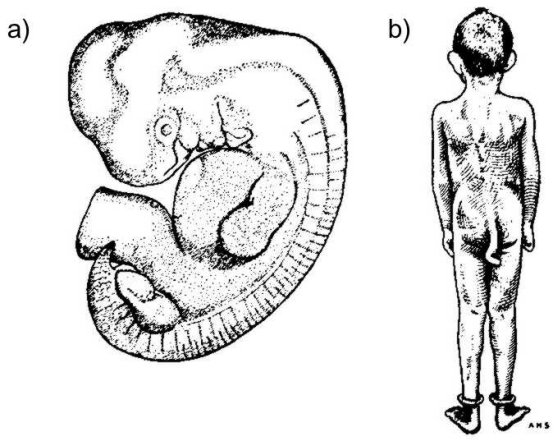
In some cases, features that have degenerated or disappeared can occasionally reappear, a phenomenon known as atavism . Typical examples include:
Tail : Although the human tail is vestigial, the coccyx still exists, and a very small number of babies are born with a movable tail.
Movable ears : About 15% of people can move their ears. This is because the anterior auricular muscles, superior auricular muscles and posterior auricular muscles have almost degenerated during the long process of evolution, but a few people still retain a certain degree of mobility.
Werewolf syndrome : Some people are born with an abnormal increase in body hair or extra ribs in the cervical spine, which is also a counter-resistance phenomenon.
The sporadic appearance of these traits suggests that the relevant genes have not been completely eliminated but are instead expressed through recessive or diluted genes.
Traces of evolution in embryonic development
Human embryos briefly develop a tail during their sixth week of development. This tail is then resorbed during subsequent development, leaving only the coccyx as a relic. If the genes responsible for the coccyx mutate or are otherwise misexpressed, the tail may persist until birth. This process illustrates the crucial role of gene regulation in evolution, determining which traits are retained and which are eroded or hidden.
Furthermore, early human embryos closely resemble other mammals in morphology, such as heart position, limb structure, and tail morphology. This phenomenon emphasizes the gradualness and commonality of evolution and provides an important basis for comparative anatomy and embryology studies.
Other evolutionary relics in the human body
In addition to the examples above, the human body also retains other more common traces of evolution:
Muscles around the ears : Most of the functions of the anterior auricular muscles, superior auricular muscles and posterior auricular muscles that can adjust the direction of the ear have degenerated.
Hair and body hair : Body hair is significantly reduced, but abnormal growth still occurs in a very small number of individuals.
Extra ribs in the neck : called cervical ribs, are an evolutionary remnant that are occasionally visible at birth.
These characteristics indicate that during the long process of human evolution, many organs and functions are in a semi-degenerate state. Their existence is not only physiological evidence, but also provides intuitive material for studying human evolution.
The scientific significance of evolutionary traces
These remaining organs and functions in the human body have important scientific value:
Understanding evolutionary mechanisms : By observing semi-degenerate organs and counter-resistance phenomena, we can trace the path of human evolution and understand the evolution of physiological functions.
Medical and physiological research : The evolutionary background of organs such as the appendix, wisdom teeth, and tonsils helps explain the mechanisms of disease and the necessity of surgery.
Behavior and survival strategies : Functions such as piloerection and grasping reflex reveal the early living environment and behavioral adaptations of humans.
These phenomena remind people that even though modern life has been separated from the natural environment, the human body still retains the imprint of evolutionary history. These “historical traces” are important windows for understanding biology and medicine.
Modern Enlightenment and the Value of Popular Science
Studying the traces of human evolution not only facilitates academic inquiry but also fosters public interest in science. Many people mistakenly believe that evolution is irrelevant to everyday life. However, by observing features like worm muscles, the grasping reflex, and the piloerection response, we can intuitively perceive tangible evidence of evolution. These vivid and accessible examples serve as valuable material for science education and popularization.
At the same time, these evolutionary relics remind us of the limitations of scientific understanding and historical biases. Humans have developed complex mechanisms for adapting to their environment and to themselves. Modern science is constantly decoding these mechanisms, correcting past misunderstandings and providing a theoretical foundation for future medical and biological research.
https://www.aclerly.com/the-grand-tapestry-of-human-evolution-traces-timeline-hair-and-future-adaptations/