https://www.aclerly.com/the-architecture-of-perception-how-the-human-brain-constructs-reality/
Display and Real World: Differences in Color Representation
In everyday life, the colors we see aren’t exactly the same as those displayed on screen. For example, yellow appears in the real world because objects absorb light outside the yellow wavelength range, reflecting only light with wavelengths between approximately 570 and 590 nanometers to the human eye. However, the yellow on a screen isn’t directly emitted by yellow light. Instead, it’s produced by a combination of red, green, and blue primary color pixels at varying brightness levels. When the blue light’s brightness is reduced, the remaining red and green mixture is perceived by the brain as yellow.
The essence of this phenomenon lies in the human visual system. The retina contains three types of cone cells, responsible for sensing light: long-wavelength (red), medium-wavelength (green), and short-wavelength (blue). Yellow light, with a wavelength between red and green, activates both red and green cones, resulting in a yellow perception. Displays achieve the same effect by adjusting the brightness of red and green pixels, creating a similar color experience in the brain.
The Nature of Object Color: Electronic Transitions and Light Absorption
The color of an object is essentially the result of the interaction between the molecular structure of the material’s surface and light. Electrons in the outer shell of an atom operate stably in a low-energy state, known as the ground state. When these electrons absorb sufficient energy, they transition to a higher-energy orbital. This excitation process absorbs energy from light. Different colors of light have different energies, with shorter wavelengths having higher energy. Electrons only absorb light waves with a matching transition energy; the rest is reflected.
For example, if the energy required for an electron transition matches that of blue light, it will absorb blue light and reflect other light. The combination of these reflected light forms the color we perceive. For example, an object reflects red and green light but absorbs blue light, resulting in a yellow appearance. This shows that color is not an inherent property of an object but rather the result of the interaction between electron transitions and light, combined with the retina’s interpretation of light, which creates a subjective perception.
Visual evolution and biological color perception
Humans have three types of cone cells, which are not particularly common among mammals. Most mammals have only two types of cone cells, resulting in a relatively narrow range of color perception. This is related to the nocturnal nature of mammalian ancestors, which led them to evolve a visual system sensitive to light intensity and less sensitive to color. To compensate for their limited color vision, mammals have developed robust senses of smell and hearing, enabling them to effectively perceive the world in nocturnal environments.
In contrast, birds’ visual cells are more complex, sensing not only red, green, and blue, but also violet and some ultraviolet light. This allows birds to discern a wider range of colors, enabling them to use them for courtship, warnings, and ecological communication. The greater the variety of visual cells, the richer and more vibrant the color perception. For example, the plumage colors of tropical birds evolved as visual signals specifically for ecological and social functions.
Mantis shrimp: A world of color beyond humankind
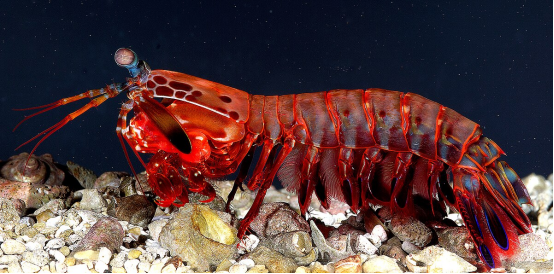
Mantis shrimp have the most advanced color vision in the animal kingdom. They possess 12 photoreceptors, four times as many as humans, capable of sensing light from red to ultraviolet, and even polarized light. However, their visual paradigm differs from that of humans; their color vision is more like a discrete channel system. While humans can distinguish colors with wavelengths differing by about 4 nanometers, the minimum resolvable wavelength difference for mantis shrimp is about 25 nanometers. This means their vision is more like selectively locking onto specific wavelengths of the spectrum to quickly capture prey, rather than integrating continuous color information.
The existence of this unique visual system highlights the adaptive evolution of color across species. Mantis shrimp rely on highly precise light perception for both hunting and survival, and their visual abilities directly influence their survival strategies. Human trichromatic color vision, on the other hand, plays a crucial role in discerning subtle differences in fruit and the environment.
Optical Principles and Structural Color
In addition to the colors produced by chemical pigments, structural color also occurs in nature. Structural color occurs through the interference of light through microscopic surface structures, causing specific wavelengths to reflect and create color. Examples include the blue or green sheen of blue morpho butterflies and peacock feathers. The rarity of blue is related to the complexity of its molecular structure. The complex conjugated double bond system absorbs long-wavelength light and reflects short-wavelength light, but the molecules are unstable and rarely occur naturally. Structural color provides a non-pigmented visual expression and is often used in ecological behaviors such as courtship, warning, and group recognition.
Chemical pigments and conjugated double bond systems
The appearance of chemical pigments depends on the conjugated double bond system within the molecule—a structure characterized by alternating single and double bonds. The greater the number of conjugated double bonds, the longer the wavelength of light the molecule can absorb, and the color shifts toward the blue end. However, the more complex the molecular structure, the lower its stability and the less likely it is to occur naturally. For example, retinol molecules absorb blue-violet light and appear orange-yellow, while synthetic titanium blue pigments require complex processes involving high temperatures and high pressures to achieve a stable blue color.
The evolutionary significance of human color vision
Human trichromatic vision may be a result of later evolution, providing an advantage for identifying ripe fruit or plant maturity. In contrast, mammals have evolved dichromatic vision, which is advantageous for nocturnal travel, while birds and insects, which require more advanced color vision for ecological signals and courtship behaviors, have developed multiple cone cell types and structural color perception capabilities. This diverse visual system reveals the complexity of biological adaptive evolution.
Summarize
Color is the product of the interaction between an object’s molecular structure and light, and the result of the biological visual system’s interpretation of light waves. From the yellow we see on a display screen to the wings of a blue morpho butterfly in nature, every color is rooted in physical, chemical, and biological principles. Human trichromatic vision, bird tetrachromatic vision, and the 12-color perception of mantis shrimp reveal how the evolution of vision is closely linked to ecology, courtship, and survival strategies. Understanding these principles can provide a deeper understanding of the wonders of color in nature and the unique way humans perceive the world.
https://www.aclerly.com/the-architecture-of-perception-how-the-human-brain-constructs-reality/