
https://www.aclerly.com/the-grand-tapestry-of-human-evolution-traces-timeline-hair-and-future-adaptations/
Introduction: The story behind the hair differences
Hair, seemingly ordinary, has played a unique role in human evolution. Compared with most mammals, humans have significantly less body hair, with only hair and beards growing continuously for many years. This phenomenon is not only bizarre, but also full of scientific and cultural significance. Why do our bristles almost disappear, while our hair can grow indefinitely? Why do domestic pets have the shortest hair on their heads? This article will reveal the evolutionary reasons behind this series of curious phenomena, as well as the important role of hair in human physiology and social culture.
The timing and genetic clues of body hair loss
Scientific research shows that humans began to lose their body hair on a large scale about 1.2 million years ago. This conclusion comes mainly from the study of the MC1R gene, which is responsible for regulating the production of melanin in the skin. Melanin not only affects skin color, but is also an important natural sunscreen. As body hair gradually degenerates, the concentration of melanin in the skin increases, becoming the main barrier to protect the skin from UV damage.
This relationship between gene and hair clearly reveals the evolutionary path of humans adapting to open sunlight environment: when body hair becomes less, skin pigment supplements the protective function and forms a new physiological balance.
Evolutionary chain reactions driven by food transition
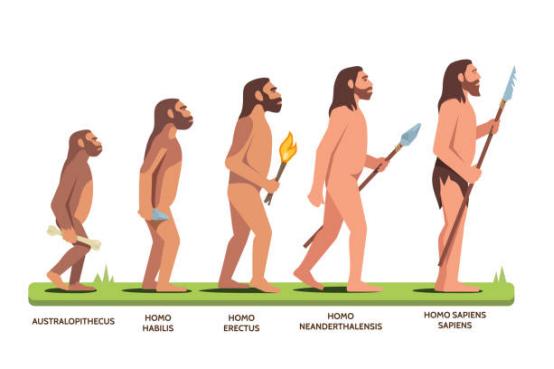
Early human ancestors, such as Australopithecus and early Homo habilis, mainly ate plants, similar to today’s chimpanzees. However, as the brain size rapidly expanded, it was no longer possible to rely solely on the energy provided by plants. Meat, with its high energy density, became an important driving force for the evolution of the brain.
But in the early carnivorous stage, due to their small size and lack of hunting skills, humans could only rely on carrion or leftovers left by predators. It was not until about 1.8 million years ago that with the emergence of Homo erectus, their size increased and they mastered the use of fire, and humans began to form a group hunting method. Although they did not yet make advanced weapons, this high-intensity hunting method greatly increased the requirements for physical functions by exhausting prey through endurance pursuit.
Physical Adaptations: The Evolution of Endurance and Heat Dissipation
The hunting method requires long-lasting endurance and efficient temperature regulation. The human body gradually adapted to this, and the slow muscle fibers were strengthened to support long-term low-intensity exercise. At the same time, sweating became a key means of heat dissipation.
If the whole body is covered with thick body hair, sweat will not evaporate quickly and the heat dissipation efficiency will be low. Therefore, the body hair will degenerate a lot, making room for sweat evaporation and improving the temperature regulation effect. In addition, the human drinking efficiency will also increase, supporting a lot of sweating and ensuring the balance between energy consumption and water replenishment.
Relationship between sweat gland type and hair distribution

Human sweat glands are mainly divided into two categories: small sweat glands and large sweat glands. Small sweat glands are distributed all over the body, especially on the forehead, palms and soles of the feet. They secrete sweat mainly composed of water and salt, and play the main role in regulating body temperature.
Apocrine sweat glands are attached to the hair follicles and secrete a sticky, odorous liquid similar to pheromones, which acts as a body odor and social signal. The hairs are mainly distributed in the armpits, pubic area and other areas, where the apocrine sweat glands are more active.
Although modern society has significantly reduced its reliance on body odor, the symbiotic relationship between these sweat glands and bristles explains why certain areas of hair still remain densely covered, along with a noticeable body odor.
Why is hair retained and its growth cycle extended?
Unlike most body hair, human hair not only remains, but also has an extremely long growth period, up to six years. This characteristic of hair has its unique significance in evolution.
The brain is one of the most sensitive organs in the human body and is extremely sensitive to temperature fluctuations. With the advent of upright walking, the head became the focal area of direct sunlight and the temperature fluctuated dramatically. Hair plays a dual role of insulation and heat preservation, helping to maintain a stable brain temperature and avoid overheating or overcooling.
In addition, hair can block ultraviolet rays and reduce damage to the scalp. For this reason, hair becomes an indispensable natural protective layer on the human body.
Sexual selection and the evolutionary significance of hair length
What is puzzling is that hair can continue to grow for a long time without significantly improving survival. Evolutionary biology suggests that many seemingly useless features are often the result of sexual selection.
The thickness and length of hair are considered a symbol of health and youth, and directly affect an individual’s attractiveness. Hair loss caused by the shrinkage of hair follicles with age often makes people look old, affecting their social life and choice of mate.
In human evolutionary history, long hair may have helped individuals stand out from the crowd and demonstrated reproductive advantages. In modern society, hair is still an important part of aesthetics and identity expression, and this ancient mechanism still affects our behavior.
The cultural and psychological significance of hair
Hair is not only a physical feature, but also deeply rooted in cultural and psychological realms. Hair styles, dyes and haircuts around the world reflect identity, religion, class and personal aesthetics.
Psychological research shows that changes in hairstyles have a significant impact on self-confidence and social interactions. Hair becomes a bridge between biological instincts and social culture, shaping our self-cognition and interpersonal relationships.
Hair, a symbol of evolution and culture
The unique phenomenon of human hair is the product of multiple factors, including genes, environment, behavior and culture. It not only records the process of ancient humans adapting to nature, but also reflects the context of social evolution.
In the future, with the development of science and technology, we may be able to have a deeper understanding of the secrets behind hair, and even use gene editing and biotechnology to reshape this evolutionary heritage.
How do you view the role of hair in modern life? How much does hair affect your self-image and social life? Share your thoughts in the comments.
https://www.aclerly.com/the-grand-tapestry-of-human-evolution-traces-timeline-hair-and-future-adaptations/